


 RSS Feed
19 Nov 2026
APULIA’S OLDEST APERITIF: BEER AND TARALLINI 2,500 YEARS AGO. UNISALENTO TAKES THE ROOTS OF APULIAN FLAVOUR TO BEIJING
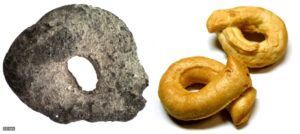
The oldest tarallino found so far is about 2,500 years old. It was recovered at Oria, among the offerings deposited at the Messapian sanctuary of Monte Papalucio. Together with research on ancient beers, it is the focus of the exhibition “At the Roots of Taste: Bread, Cereals and Fermented Beverages in Ancient Southern Italy” (“Alle radici del gusto. Pane, cereali e bevande fermentate nell’Italia meridionale antica”). The exhibition is curated by the University of Salento and coordinated by professors Grazia Semeraro, Florinda Notarstefano and Girolamo Fiorentino. It opened today, 18 November, in Beijing, at the Embassy of Italy’s event “Merenda italiana”: Italian and Apulian Bakery Products – Tradition, Wellbeing and Opportunities for the Chinese Market. The event is part of the 11th Italian Cuisine Week in the World, which this year has Puglia as its guest of honour.
The exhibition consists of four panels with texts in Italian and Chinese, and moves from the general picture to specific case studies. It draws on archaeological discoveries from settlements in ancient Apulia, the result of research the University of Salento has carried out over several decades. Particular attention goes to the bioarchaeological and archaeometric studies conducted in the University’s laboratories.
The first panel introduces food in the ancient world: the main resources (cereals, pulses, olive oil and wine), the sources used to study them (written texts, iconography, plant and animal remains) and the origins of what we now call the Mediterranean diet. The second turns to diet in ancient Apulia, with a focus on the Salento of the Messapians and the Greeks. It ranges from the oldest bread yet found in Apulia, recovered at Roca and dated to the 12th century BC, to the plant offerings and flour-based preparations (“bakery products”) found in significant quantities at the sanctuary in Oria. The final section follows the path “from grain to bread, from cereal to beer”: the stages of cereal processing, from milling to baking, and fermented beverages. Chemical analyses carried out at the University of Salento on vessels from the village of Castello di Alceste (San Vito dei Normanni, 8th–6th century BC) identified traces of fermented beverages made from cereals, probably barley, and fruit. Each panel carries a QR code linking to a further-reading page in Italian and Chinese, with additional text, image credits and bibliographic references.
At the heart of the exhibition are discoveries made by archaeologists of the University of Salento’s Department of Cultural Heritage. The Department is directed by Girolamo Fiorentino, professor of Bioarchaeology and Archaeobotany.
Among these are the finds from the excavations at the sanctuary of Monte Papalucio in Oria. Work there began in the late 1970s and early 1980s and revealed the kinds of offerings made to Demeter and her daughter Persephone. Alongside goldsmiths’ work, including gilded silver foil plaques that once adorned the garments of the cult images, the gifts burnt during sacrifices have also survived: figs, pomegranates, and ears of wheat and barley. Among these charred remains were cereal-based doughs with the unmistakable small, ring shape of the tarallino. Scanning electron microscopy showed that they were made from finely ground wheat flour and unleavened dough. They are the earliest known examples of one of the most characteristic products of Apulian cuisine. The finds were recently conserved and have returned to Oria, where they now form part of the collections of the Museo Archeologico e dei Messapi (Archaeological Museum and Museum of the Messapians).
The other discovery concerns beer. University of Salento research at the site of Castello di Alceste, directed by professor Semeraro, documented the production of cereal-based fermented beverages. More recent work has been carried out under the PRIN 2022 PNRR project “POTOR. People, Pots and Drinks: An Interdisciplinary Approach to Drinking and Commensal Practices in Pre-Roman Southern Italy”. The project is funded by the European Union – NextGenerationEU and professor Notarstefano is its Principal Investigator. The team examined 99 Iron Age vessels, combining organic residue analysis, the study of plant microremains, use-wear analysis and experimental archaeology, including brewing barley beer in a reconstructed vessel. The results, published in 2026 in the journal Heritage, show that the locally made decorated pottery was used to prepare and serve fermented beverages based on cereals, fruit and honey, flavoured with herbs such as thyme and with pine resin. These were prestige drinks, controlled by emerging elites and shared at community feasts.
«Bringing the story of bread and beer in ancient Salento to Beijing – says professor Semeraro, co-director of the An-Lai School and coordinator of the partnership with Northwest University in Xi’an – means telling a story that Chinese audiences know well. In China too, cereals are the foundation of food culture. The analyses of the vessels from Castello di Alceste show that between the 8th and 6th centuries BC the indigenous communities of Salento already knew how to turn barley and fruit into fermented beverages. This was sophisticated technical knowledge, bound up with moments of gathering and ritual. The exhibition grew out of our collaboration with Northwest University in Xi’an, which has already produced the An-Lai School’s double degree programme in Cultural Heritage. Italian and Chinese students study together, earn two degrees recognised in both countries, and learn to look at heritage from two different perspectives. It shows that archaeology studies not only monuments but also the everyday gestures that are still with us today. And it can become common ground on which to build lasting ties between people and institutions».
«We are delighted to present this exhibition in Beijing during the Italian Cuisine Week in the World, which this year has Puglia as its guest of honour – adds professor Notarstefano -. We thank the Embassy of Italy in Beijing for inviting us to an event devoted specifically to bakery products. It is the ideal setting to show that behind a food we eat today lie a very long history and rigorous research. We chose to produce all the content in both Italian and Chinese because we wanted an exhibition that Chinese visitors could genuinely make their own. It is a small example of how a university can take its research beyond the lecture hall and the laboratory and become a bridge between cultures that share a deep respect for tradition and for food».
«What has arrived in Beijing is the outcome of work that begins with minute traces: a charred seed, a fragment of dough, a residue at the bottom of a pot – says professor Fiorentino, head of Department -. Archaeobotany and laboratory analysis allow us to read in these remains which plants were cultivated, how they were processed and what place they held in the life of ancient communities. This knowledge comes from dialogue between archaeologists, botanists and chemists, and our Department has cultivated it in its laboratories for decades. Yet looking at the past also helps us think about the present. Understanding the cereals and farming techniques of antiquity means rediscovering a biodiversity we are at risk of losing, one that can help us rethink a more sustainable agriculture, able to adapt to a changing climate».
The exhibition forms part of the mission of the University of Salento delegation to China, led by the Rector, Professor Maria Antonietta Aiello, which continues until 19 November. Its aim is to show Chinese audiences how ancient some of the gestures and products that still define Italy’s culinary tradition are, and how archaeological research can tell their story and bring them back to the present.